Tuesday, January 26, 2010
How much should Banks give back??
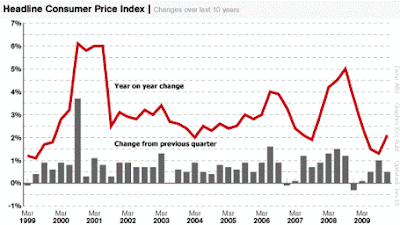
Inflation and interest fears

Wednesday, January 6, 2010
Public transport efficiency in a standard work week environment
There has been a running discussion between Cameron Murray and myself in the comments section of one of his blog entries and I decided the issue deserved a blog entry unto itself.
As a throw away comment, I mentioned that there may be some efficiencies in public transport provision stemming from the standard work week. I may have started something here I cannot finish but I'll try anyway.
Increasing the use of public transport utilisation is efficient in that it reduces the average cost of provision, it reduces expenditure on private motor vehicles and it reduces the environmental externalities resulting from private motor vehicle trips.
The standard workweek increases the convenience of public transport and, as such, increases the number of people utilising public transport services. Ceteris paribus, increasing the number of people using public transport reduces the average* cost of provision per user.
Furthermore, on a general equilibrium level, having strong public transport utilisation provides significant efficiency benefits to society through reduced investment in, and use of, private motor vehicles. For example, if every bus takes two full loads of commuters to work each day, it would reduce the number of motor vehicle trips by over 100. This reduces commuters’ need to purchase a car and reduces the environmental externalities coming from the saved trips.
So, if there are efficiency benefits from improving public transport utilisation, how can we make public transport attractive to commuters? By making it convenient.
Taking a step closer and looking at only the efficiency of public transport provision (as opposed to efficiency of society), there is always going to be a trade of between efficiency and convenience in public transport provision (up until the point where there is sufficient critical mass in a city to efficiently provide constant public transport services – every ten minutes or so, 24-7).
The idea of inefficiency in public transport provision comes from having capital (both human and mechanical) being underutilised or lying idle. Having an even flow of people throughout the day (as opposed to a standard workday with peaks in the morning and afternoon) could mean that the same number of people could be serviced by fewer busses and trains. And this would be seen as an efficient outcome: i.e. if the same number of people could be serviced by public transport with fewer resources dedicated.
However, public transport utilisation, (as opposed to provision) is linked to efficiency in the convenience sense (and the economic sense on a societal level). In order to make busses and trains attractive to commuters, services must be far-reaching and constant, at the times when people need them. If services are not convenient – both in timing and route – the number of people utilising public transport will be low.
Moving away from the peak-period public transport would considerably reduce the convenience and thus utilisation on public transport. By moving away from peak periods to an even-flow of commuters throughout the day, the average time a commuter has to wait for a bus or train would increase (because the services would not be as regular as they are in current peak times) and the average distance that commuters have to travel to get on public transport would increase (because services to outlying areas would become unviable).
As such, the number of people using public transport would decrease over time because it would be inconvenient to use it. This would reduce the efficiency of the public transport system and society as a whole.
I guess if we break it down to first principles, in both an even-flow** and a peaky workday model, there would only be two efficient public transport provisions:
(1) zero investment with zero commuters (which would be inefficient for society as a whole); or
(2) a city with 24 hour critical mass to run constant services 24-7 – of which there are few examples in the world, perhaps Manhattan and Tokyo could be efficient.
As such, if efficiency in public transportation is the goal, irrespective of whether we are an even-flow or peaky workday economy, we should have no public transport.
If instead, efficiency in the economy as a whole is the goal, then the model that would meet the needs of a greater number of commuters would be the most efficient.
To me, that would clearly be the peaky workday model.
*marginal costs in infrastructure investment often provide poor a measurement of effeiceincy due to the peakyness of investment. e.g. the MC of adding one person to a full buss is the entire cost of a new bus, the MC of adding a second person is (near to ) nothing. As such, while a little rough, average cost is a useful tool when measuring efficiency.
**every time I type even-flow I’m reminded of Pearl Jam... “thoughts arrive like butterfli-ies... oh, he don’t kno-ow so he chases them awayayay".
(I'd also like to note the irony of two cyclists arguing about PT).
Wednesday, December 2, 2009
Where does money come from?
I love reading the stupid comments posted by CM readers.
Today I had the pleasure of reading through some classic comments that made me wonder - where do people think money comes from? Do people really think that the government's money is unrelated to their own?The article Queenslanders face electricity price hikes - Queensland households could soon face electricity prices that rise and fall with the temperature outlined the Queensland Competition Authority's (QCA) proposal to have different electricity tariffs in summer and winter, to reflect the higher costs of electricity over the summer period.
In its recently released Final Report - Review of Electricity Pricing and Tariff Structures, the QCA 'recognised that adding a seasonal component to some tariffs could be warranted'.
Irrespective of the outcomes of the report, what astounds me is that people think the outcome is related to public sector greed.
Notwithstanding considerable inefficiencies in the public sector, it’s not like the public servants are lining their pockets with tax payers money. Any over recovery of taxes simply gets spent in future years (like this year).
Fair enough, some of the comments show an interested person that needs to have the situation explained to them a little better (or who should read the QCA report rather than just the Courier Mail article), but generally speaking the comments show a complete lack of understanding of both the situation and of basic public finance.
'Just another way for Bligh to tax Queenslanders once more'
'hmmm.. so this means I'd pay more in summer because I use my airconditioner etc and therefore put a greater strain on the system by using more electricity? Umm.. sorry.. maybe I'm missing something here.. don't I already pay more in summer by the fact that I USE more electricity anyway? Obviously this is just another Bligh method of screwing us all over. Sooner this government is gone the better.'
'For Chrissake Electricity is a basic right. We pay enough for it now. Is it to become the right of the rich?'
'To hell with real costs; bring back the system we have had for the last 100years where we were not paying an arm and a leg for electricity.'
'You know how much more can these blood sucking leeches get out of the QLD people. They come up with all types of excuses and reasons but it all comes down to they just want to rip us off as much as humanly possible. Dont forget it was labor that got us into this mess with electricity with Peter Beattie promises of
cheaper power and now look whats happening. Can you image what it will be like when Bligh sells off all of QLD.'
And of course, my favourite comment always comes from the conspiracy theorist:
'I will never have one of those government meters in my home, they will be used to spy on me and my family and eventually will be used to switch off any of my appliances the government does not like. Seig Heil Herr GoAnna!'
Sunday, November 22, 2009
Speed Camera's: The User Pays System
Clearly there would be some argument that this would be hitting people while they are down, especially given that it is often those people in the lower socio-economic categories that are repeatedly in trouble with the law. But surely a fine is better to face than a jail term.
And either way, people should take responsibility for their actions. If you act in a way that requires a significant amount of police time, you should pay for that time.
If you speed, and are so stupid as to not slow down after the third "speed camera ahead" sign, you should suck it up and pay your fine.
If it was me, I wouldn't complain, I'd keep my mouth shut. I wouldn't want anyone to know I was dumb enough to get caught by a stationary speed camera.
If nothing else, you can always try the Mythbusters approach to avoiding speed cameras.
Thursday, October 29, 2009
Don't wreck the RECs by Reg'ing them.
The price of RECs has dropped significantly recently. Clean energy industry participants such as the Clean Energy Council suggest that a primary driver of this price reduction has been the considerable uptake of solar hot water heaters in Australia. This uptake has been spurred on by the recent increase in government rebates offered under its $96bn stimulus package.
Matthew Warren, the chief executive of the Clean Energy Council, is quoted as saying that the low REC price:
“will not deliver against the government’s objectives of developing a world class, competitive, clean energy industry”...and ...“A government regulator or carbon bank could solve the short-run problem in the REC market by either setting a floor price of buying enough certificates to support the price to a level that would trigger broader investment”.
Mr Warren somewhat spuriously likened the actions of the carbon bank to those of the RBA acting in international money markets to stabilise the dollar.
The saga continued on The World Today on ABC radio with Oliver Yates, the head of Utilities and Climate Change at Macquarie Group proclaiming a similar view:
“So if the REC price is low, it signals to the market that it should not be proceeding with a large renewable project. Currently the REC price is quite low, and therefore there is some question as to whether it will stay that way and therefore jeopardise some of those renewable projects. But what the Government probably needs to do is step into the market and buy some of the RECs which are in excess supply”.
Mr Yates went on to say:
“A little bit of market intervention (is needed) at the moment. But they (the government) can hold on to them, they can bank those RECs and hold them, and they can release them later into the market when the market price improves”.
In answer to Mr Warren’s concerns, the development of a world class clean energy industry is a tool, not an objective. It is a tool that can be used to reduce the environmental footprint of our energy market and to reduce our reliance on non-renewable fuels. If we can have these two objectives, without a world class clean energy industry then great. Who cares about being world class?
More to the point, what the hell is a ‘world class’ clean energy industry anyway? I would have thought that a clean energy industry would be the one that was able to meet the MRET requirements at the lowest possible market cost. Wouldn’t then the low price REC price suggest that we are well on the way to having a world class clean energy market.
And to Mr Yates, if buying up and holding RECs until the market improves is a suitable investment strategy for the government, why isn’t Macquarie following your advice? Also, how is the government buying up all the surplus RECs (or worse still, setting a price floor) ‘a little bit of market intervention’, that would be a very large bit of market intervention.
Personally, I think it is great to see the Australian people putting their (and the government’s) money where their mouths are and buying into the solar power market. The use of domestic solar panels could significantly reduce the need for expensive additions to the electricity network through providing generation in the areas of consumption.
I think we should go further faster. In spite of all the hoo-ha around the development of the MRET scheme – which electricity retailers suggested would send them (and every Aussie battler) broke – it appears as though we are meeting the current targets easily and now have a surplus. And, judging by the REC prices in the market, the MRET scheme should not have significantly impacted the price of electricity at all.
Finally, if the government is going to play any role in the market, surely it should be to bring forward the 2020 target of 20% renewable energy. Clearly its current targets are too soft.
Wednesday, October 21, 2009
The 'Spirit' of Australia
Remember back in the day when there was no competition in the air market in Australia when Qantas was one of only two airlines. How much did it cost to fly? It was bloody expensive. And why? Because Qantas was ripping us off blind.
In spite of lower fuel costs, lower wages and cheaper booze and food, flights were significantly more expensive back then than they are now. We were all robbed by Qantas. But now, they somehow command reverence as being ‘truly Australian’. They stand for everything Australia stands for – the spirit of Australia.
But is screwing others over really the Spirit of Australia?
I find this a hard question because we would all like to say ‘no, Australia’s spirit is one of a relaxed , easy going, generous nation’. But is that really the truth? It seems that all too often we Australians are happy to screw others over, or at least sit back and watch other do it. It is part of our culture. If, like Qantas did for decades, you can screw someone over without going outside the law, it is fine. It’s good business. Good leadership.
Take for instance the way the Government is currently treating the Tamil refugees that are now back in Indonesia. If the refugees had landed on Australian soil, the government would have to look after them. That’s what the law says. But, intercepting them before they reach land and sending them to a third party nation to sit and starve in a boat is totally fine. It’s not illegal, it’s good leadership.
Irrespective of the rebuke that the Government is currently getting in the media over the matter, a large number of Australians think that this is the right way to deal with refugees.
Is that what the ‘spirit’ of Australia has come to? Do we, want Australia to be known as a closed, greedy country - a country full of people who will screw people over whenever they can do it legally?
I would rather we be known as a ‘fair go’ country. A country that accepts people that have been persecuted in other countries – not a country that locks them up in detention. A country that cherishes its diversity – because, after all, we are almost all new to this country.
That’s the ‘Spirit of Australia’ to me.