Frustrations with the Greens - again.
I am not a swinging green voter. Rather, I have voted green in every election since I joined the electoral roll in the late nineties. I have a lot of time for Bob Brown, and I think the party at large has provided benefit to Australia.
However, there have been a few instances lately where I've had cause to question my alegiences. This recent media release is one of them.
It is pure political guff, full of overstated and missleading information used to skew people's views and knowledge on the discussion of renewable energy.
The fact that renewable energy nameplate capacity for renewable energy has taken over that of nuclear plants is irrelevant - energy dispatched into the market it the key. Nameplate capacity is how much electricity a power plant, solar cell or wind farm could theoretically produce at maximum output. Energy dispactched is how much electricity is actually produces.
One of the biggest problems with renewable energy is that it cannot be relied on to produce anywhere near its nameplate capacity over a period. Solar panels, for example, don't work at night, and wind farms don't work when there is no wind. This reliability issue with why, when working out the total capacity of the National Electricity Market (NEM) in Australia, the Australian Energy Market Operator (AEMO) only allocates 20% of nameplate capacity of renewables. That is, it can only count on renewable energy sources to provide one fifth of thier nameplate capacities.
Nuclear however is 24/7. It can produce up to its nameplate capacity when needed, and turn down (with limitations) when not.
The key here is that the Greens are trying to paint renewables as something they are not - credible power sources that can be relied on, and sources that are comparable, or better to, nuclear.
The thing that really got the hair on the back of my neck up was the final paragraph where it was suggested that nuclear power could not operate without the subsidies it received from Governments around the world.
HELLOOOO, pot calling the kettle black.
Where is the mention of the Large-Scale Renewable Energy Tartget (LRET) Scheme and the Small-scale Renewable Energy Scheme (SRES). What about the solar feed-in tariffs? Without being subsidiesed by every energy user on the east coast of Australia, renewable energy is dead in the water. It's all over for it.
The frustrating thing is that there are some great things happening in renewable energy in Australia. We have a Government that is promoting renewable energy. Renewable energy is becoming more important in the Australian market. And, maybe, someday, renewable energy will become a viable alternative to coal, gas or nuclear power. But rather than focus on these positives, the Greens have used some spurious data and ilogical arguments to try and spin the situation.
How about the truth please?
I'm disapointed. I've come to expect this sort of crap from the Labor and Liberal parties, but it sadens me to see it come from the Green, a group that I had thought prided itself on honesty and integrity.
Wednesday, April 27, 2011

Wednesday, March 16, 2011
Pondering my misspelt youth
I had a great faux par at work today. I sent an email to the whole organisation with the following link to this site on the Tsunami in Japan. Subject for the email -
'Sunami - before and after'
'Epic fail - Tsunami is spelt with a T'
'Spelt is a grain used to make bread - you want spelled'
- Spell check does not work on subject line
- Take a second to look for obvious mistakes in emails before sending to peers and bosses
- Do not reprimand others on spelling unless you know what you are talking about
Thursday, February 3, 2011
Firearms - concealed or open? Both bad
While I dislike fire arms intensely, the arguments about concealed vs unconcealed weapons has taken my eye in recent times. None of it makes sense to me, but definitely the argument that concealing weapons makes it safer for Joe Blogs.
A mate of mine has just sent me a video of a fold-up machine gun. He wants one for Christmas. As often happens with this friend, our views differ. I find this sort of thing quite disturbing.
The argument between concealed vs. blatantly obvious weapons is an interesting one.
Clearly the chances of being mugged with a big Smith and Wesson on your belt are low. However, many firearm pundits argue that allowing concealed weapons make people safer, on average. Their view is that, while openly carrying firearms protects the carrier, it sends the message to would-be muggers that anyone without an obvious firearm is unarmed – the perfect victim. However, if all weapons are concealed, the would-be mugger is unable to separate the persons that are armed from those that are not – thus making mugging anyone more risky.
But, if you are in a location where you are allowed to conceal weapons, and you are the sort of person that feels that they need a weapon for self defense, why would you conceal it? Surely you would want to make your 'protection' as obvious as possible*. Yes, the would-be mugger might be be hesitant to mug someone if he/she was unsure if they were carrying a weapon, but someone who might be carrying a weapon has to be far more attractive to mug than someone that definitely is.
Worse still, the only persons that would have an incentive to conceal his weapon is the would-be mugger - because he would want others to see him as harmless until it's too late.
I’d prefer if people just didn’t carry guns. I'm glad to live in Australia where they are uncommon.
Sunday, January 9, 2011
Politics - a dirty word
Why won’t our leaders lead? And, how could they expect us to believe in them if they don’t hold any beliefs?
I regularly hear other people talking about politics at work and I can’t seem to get interested in it. The problem is that I see politicians as conniving weasels that will do and/or say whatever it takes to win the next election. Politicians, in my mind, do not appear to believe in anything. They appear bereft of any individual thought – being only able to tow the ‘party line’.
But here’s the problem, the ‘party’ line is no longer based on any central tenet. With potentially the exception of the Greens, I can no longer base my voting decision on a set of ideals that both the party and I share. Tenets such as economic liberty or worker protection are largely gone from our political system.
For instance, surely the shadow treasurer, Joe Hockey, as a Liberal Party member, should oppose government intrusion in the financial system, and yet he is always going on about how the current Government should increase regulation in the banking system to reduce the rights of banks to increase interest rates (here).
Whether there is a need to intrude in the banking system or not, surely the impetus for this type of policy should be coming from the workers party – the ALP – rather than the Liberal Party.
Populist and median voter policies frustrate me to no end. If you want to lead a country – work out what you believe in, choose a party (or not) that suits those beleifs, grow some balls (figuratively, ladies) and stick to your guns.
Don’t be one of those snivelling little people that are so scared of losing their job that they don’t speak up when they see something that is wrong or against your beliefs. Instead, try your hand at leading.
Tuesday, November 16, 2010
Simplicity Through Complexity
I just watched this interesting presentation on TED by Eric Berlow. Eric is a biologist that researches complex ecosystems and he has found that taking a step back and looking at the big picture often enables simple conclusions to be drawn.
Good economists follow a similar approach. It is important to expand your field of vision in order to understand a whole market, or a system of markets. Only once the whole system is understood can you draw conclusions about what is happening on a micro level.
The most important line I got from the presentation was:
'the more you step back and embrace complexity, the better chance you have of finding simple answers, and it's often different to the simple answer that you start with...(if you had not taken a step back)'
So next time you are faced with a complex issue, take a step back and try to understand the big picture. You might find that the answer you are looking for is more forthcoming in a big picture analysis, and you are likely to come to better conclusions as you will understand the flow on effects of your potential actions.
Friday, October 29, 2010
Where does the future start?
When forecasting or planning for the future, is our vision irreparably blurred or skewed by the present?
This morning I read the beginning of Keynes' 1919 book The Economic Consequences of the Peace. Keynes wrote this book because he was unsatisfied with the resolution of the first world war - he felt that the political and economic decisions made in the wake of the war were so one-sided and unfair that they would result in Germany rising up in anger once again.
He was right too.
But what struck me was Keynes’ observation of human nature – that we expect the status quo to go on forever.
I found the opening lines quite moving - it made me question what the future holds for Australia. It seems like Australians are happy to chug along in their lives, satisfied that the economy will continue to turnover at a great rate. This national resolution to relax and wait for the commodity royalties to trickle though the economy has won us plenty of attention throughout the world, but how long can the commodities be relied on?
The power to become habituated to his surroundings is a marked characteristic of mankind. Very few of us realize with conviction the intensely unusual, unstable, complicated, unreliable, temporary nature of the economic organization by which Western Europe has lived for the last half century. We assume some of the most peculiar and temporary of our late advantages as natural, permanent, and to be depended on, and we lay our plans accordingly. On this sandy and false foundation we scheme for social improvement and dress our political platforms, pursue our animosities and particular ambitions, and feel ourselves with enough margin in hand to foster, not assuage, civil conflict in the European family.
Are we basing our plans for the future on sandy and false foundations? Are we too caught up in the present to realise how fleeting the present really is...was?
Thinking about it in modeling/forecasting terms, it appears that our estimates of the future rely too heavily on our most recent experiences. While we understand that the logical starting point for the future is the present, we may fail to recognise if the present is an outlier (not along the long-term trend line). If the present is an outlier, then it is not a good base for a forecast.
But is this the myopic nature of the human race? I find it somewhat ironic that our minds have sufficient power to know that we have to plan for the future, but they are not powerful enough to net out the effects of our current situation in order to make our future plans more realistic.
This bias for the present affects everything that we are; our mood as walk down the street, our ability to perform at work (or elsewhere) and our plans for the future (it can even affect our memories of the past). Everything that we do, see and perceive is affected by our present or our immediate past.
I wonder how I can best net out my current perceptions in order to better understand the future?
More importantly, how do I start planning for the future if the future doesn’t necessarily start with the present?
Monday, October 25, 2010
Driverless car to save us from the oldies
Googgle is making a driverless car to account for the dangers of the ageing population.
I say bring it on - I can't wait to be able to set the car to Autopilot and snuggle up next to Maple and Anna in the back seat. Sleepy time... here I come.
Sadly it's a few years off yet.
Sunday, October 24, 2010
GenerationOne
Did anyone catch the address from Madeleine Madden last night?
GenerationOne looks like a great initiative- you should check it out.
Wednesday, October 20, 2010
Spending cash to save money??
Can cash make me skinnier? And, more importantly, can spending cash save me money?
A recent study has shown a link between using credit or debit cards for supermarket shopping trips and buying unhealthy impulse items. The study found that people who pay by cash for their groceries were less likely to purchase unhealthy impulse products than those paying by credit or debit cards.
The study suggested that the 'pain' of handing over cash for these types of products outweighs the 'benefit' that people perceive that they would receive from purchasing (and consuming) them. Paying on a card however dulled down this 'pain' such that the 'benefit' of purchasing the product relatively outweighed the pain.
This study was picked up by a few online news sites yesterday (news.com.au). The articles suggested that I could lose weight if I used cash for my grocery shopping.
In spite of yesterday's blog (questioning whether I should get a gym membership), it wasn' t the weight loss component of this article that interested me, but rather the question - could spending cash save me money?
The way I saw it, having a fixed amount that I could spend (and the relative 'pain' of handing over the cash) might stop the overspend that appears to happen when I walk into a super market.
In my ponderings, I realised that the vast majority of my family's grocery shopping was actually done by my wonderful wife, Anna. So, I sent the article to her. Just a little nudge, suggesting that she try using cash rather than card when shopping.
Anna's reply was timely and succinct. She suggested that, while this technique would save her money at the supermarket, it would cost her money everywhere else she goes. In her view, having cash made her spend more money. And, I'm inclined to agree with her, given my experiences.
Anna's hypothesis was that she generally won't put anything less than $10 on a card. While she acknowledged that there are a large number of shops that have a $10 minimum purchase for card transactions, this wasn't the reason. Rather, it was that she felt embarrassed making small purchases on a card.
What does this mean? If Anna is walking past a cafe and gets mesmerised by the smell of coffee, she will buy a coffee if she has cash on her, but will keep walking if she only has her card. the same guys for a cheeky chocolate bar, bag of chips, magazine... the list of potential impulse buys is endless.
This aligns perfectly with my experience. If I start the work week with no cash in my wallet, I can regularly get to Friday without spending a cent. However, if there is cash my wallet, I appear to haemorrhage it all over the place. The amount I can spend seems limitless.
What does this mean? While using cash at a supermarket may reduce the number of impulse purchases you make at the supermarket, it could actually increase the number of impulse purchases you make elsewhere. And, all other things being equal, there's a good chance that impulse purchases would be cheaper at the supermarket than at smaller stores.
But, does this mean that I have to plan my impulse buys?
Are you allowed to do that?
Maybe I'll just suggest that we use cash at the supermarket, and then hide the residual cash under the bed until the next week's shopping trip.
- Take a list - people who shop with a list tend to spend less.
- Use unit pricing to compare value for money, as buying in bulk is not necessarily always the cheapest option.
- Shop alone - people who shop as a couple tend to put more in their trolley.
- Avoid big supermarkets if you just want to pick up a few things - you're better off in a small store.
- Don't shop when you're hungry - it's a sure-fire way to end up with a trolley full of unnecessary purchases.
Inexplicable gym thoughts
I've been thinking of getting gym membership, but I'm not sure that I can bring myself to do it.
While I enjoy fitness, I generally don't like the idea of gyms, there is something unnatural about standing around in front of mirrors lifting metal. And, while I like the classes, these appear to be the 'women's territory' in the gym. It's not that I don't feel like I am welcome, it's more the looks I get from the beefed-up gents out in the manly metal-lifting section that make me feel uncomfortable.
I also appear to have some inexplicable moral issue about a business that makes its money by signing up 'members' and locking them into contracts so that the 'member' pays irrespective of her/his use of the gym. I often wonder how many gyms would operate profitably if only those that used the gym paid their membership fees. The flip side being how packed would a gym be if every member were to use it on a reasonably regular basis?
Not sure where the moral issue comes from. It seems like a reasonable business decision. It is also the same tactic that my telephone and internet companies use. But for some reason it irks me with gyms.
I should probably get over it.
Monday, October 18, 2010
The Parody of Parity
Australia is currently alight with conversation relating to reaching 'parity' with the USA dollar. While I am certainly happy about about the 1:1 parity being achieved, I do not think it deserves all the hype.
Interestingly, the BMI suggests that Australia is really at parity with the USA at an exchange rate of around 0.85USD, but this is somewhat higher than the exchange rate that matters to me.
1:1 parity is an accounting benchmark. While it looks great on paper, the fact that our respective dollars happen to have passed each other in the night doesn't change anything.
The real benchmark is purchasing power parity (PPP), the exchange rate at which products in each country cost the same relative to the exchange rate. For example, a chocolate bar that sells for AUD$1.50 in an Australian city should cost US$1.00 in a U.S. city when the exchange rate between Australia and the U.S. is 1.50 USD/AUD. (Both chocolate bars cost US$1.00).
The benchmark for tongue-in-cheek PPP is The Economist's Big Mac Index. The Economist has been running the BMI for as long as I can remember and, despite its simplicity, it provides an interesting and tangible expression of over- and under-valued currencies around the world. This site has a 'live' version of the BMI which is updated daily in accordance with changes in the exchange rates.
Interestingly, the BMI suggests that Australia is really at parity with the USA at an exchange rate of around 0.85USD, but this is somewhat higher than the exchange rate that matters to me.
To me, 1:1 parity and PPP are far less important than my arbitrage parity - that is, the point at which it is cheaper for me to import my consumer goods (technology, clothes, shoes etc.), than to purchase them here in Australia. In essence, this is the same as PPP, but also takes into account transport costs, exchange rate costs (bank fees etc.) and a risk premium (which I apply to all internet purchases).
I were looking to purchase a Big Mac, my arbitrage parity would be at some point above 0.85USD, but it seems like most of the goods I like to purchase I can source considerably cheaper in the USA. As such, my arbitrage parity is typically at an exchange rate of approximately 0.65USD. Anything on top of that is cream on the cake - or savings in the bank as the case may be.
When purchasing running shoes for instance, I can source shoes from the USA for $125USD (including postage) that would cost upwards of $250AUD. This reflects an arbitrage parity of 0.5USD. In addition to this (and the original reason for importing shoes), I am able to import the shoes that best suit my feet.
Technology often provides a lower discount in the USA and, therefore, my arbitrage parity is higher. A Macbook for instance costs $1,000USD and $1,250AUD. By the time I find someone willing to sell it to me (Apple USA won't ship to Australia), and pay for postage, my arbitrage parity would be closer to the BMI parity of 0.85USD.
The most considerable benefit to me of the 1:1 parity is that it widens the scope of goods that I can reasonably import - that is, as the exchange rate improves, a greater range of goods will become viable to import.
I wonder what I should import next?
Quantitative easing - printing money to win
There's been a bit of a kerfuffle lately about the USA printing money, but it doesn't appear that unreasonable to me.
What are the key issues that arise from printing money?
- Inflation
- Devalued dollar
- Potentially, increased spending
These are all good outcomes for the USA.
While inflation will most likely be an issue in the States in two to three years, the US currently has a far more pressing issue - stopping negative price growth (deflation). Price growth is still well below the long-run average and, with the US economy struggling to show signs of life, the Fed is concerned that prices will return to negative growth. In its view, anything that can ensure the price growth stays positive is a good outcome.
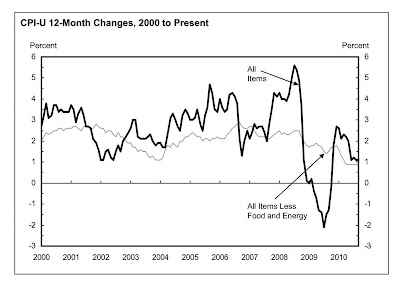
The devaluation of the dollar would also appear to be a reasonable step for the USA to take. While volatile, the US dollar has stayed reasonably strong over the last few years. This is surprising considering that the USA was one of the main contributors to the GFC. While there was an initial run on US dollars, when the rest of the world crashed we saw a 'flight to quality' (i.e. everyone bought US dollars). This flight to quality led to an appreciation in the US dollar and has hampered the US's ability to get out of the recession. A devaluation of the US dollar (as we are currently experiencing), while painful for some investors, would appear to be in the best interest of the US economy.
Finally (and intrinsically linked to inflation), the whole idea if expanding the money base is to increase activity in the economy. If nothing else, the threat of future inflation should in itself encourage people to spend their money rather than save it.
This guy and this guy appear concerned about the quantitative easing, but they also both have vested interest in keeping the US dollar high, not in improving the US economy. The first guy looks suspiciously like a Wallmart employee to me - maybe the Tea Party suggested that he get a suit and camera off the shelf in his lunch break and make a video.
Anyway, I'm all for the US printing money - let's just hope that it works.
Tuesday, September 28, 2010
Disconnect rather than connect - unnecessary electricity disconnections in QLD
Is it lack of communication, lack of communication skills, pride or stupidity?
The Queensland Government has mandated that electricity retailers are not allowed to disconnect customers who phone up and ask the retailer for more time to pay a bill. Retailers are required to develop a payment plan for customers in hardship, to ensure that the retailer eventually receives it money and the customer does not loose power.
And yet, in light of these requirements, each year in Queensland, approximately three times more people are disconnected than are placed on payment plans. This was noted by the Courier Mail here.
The large number of disconnections suggest that consumers are unaware of their rights, but whose responsibility is it to let them know?
While it would be easy to suggest that electricity retailers and/or Government should invest more to inform consumers of their rights, surely there should also be a requirement on a consumers behalf to fess-up when they are having trouble paying their bills.
Disconnections happen because consumers (including myself) put their head in the sand and hope the problem will go away rather than communicating with their retailer. In this instance, a consumers' lack of communication skills may be causing that consumer considerable hardship.
Monday, April 12, 2010
The importance of being earnest
Recently, I was invited to chat with students at both the University of Queensland (UQ) 'Careers and Cocktails Night' (run by the UQ Economic Society), and the Queensland University of Technology (QUT) 'Town and Gown Evening' (run by the QUT Economics and Finance Society). The events are very similar in nature - a chance for students in the latter years of university to meet some potential employers to show off their wares.
Both evenings were enjoyable. I like getting together with students for a beer - at heart, I'm still a student boozer. I miss how how simple life was at Uni.
The same trends came up in many of my conversations at the evenings.
Students stand there and listen to me tell them... 'be yourself, and be honest about your capability and personality' (I feel so old when I say things like that). And recruiters/employers stand there and tell me that all they are after the best fit person for the job.
I think employees and employers are equally at fault in this arena. When sitting in an interview, potential employees all too often skirt around areas of inadequacy and pump up areas of relative competency. Similarly, employers talk of fun and relaxed corporate atmospheres and refer to policies that proffer work/life balance, but that haven't been adhered to since their inception.
And yet, no one is honest in interviews. Everyone stretches the truth a little (or a lot) to make themselves look like the right person for the job, or the right workplace for the person. and what does it mean? Employers hire the wrong people and employees end up in jobs that aren't right for them.
I think employees and employers are equally at fault in this arena. When sitting in an interview, potential employees all too often skirt around areas of inadequacy and pump up areas of relative competency. Similarly, employers talk of fun and relaxed corporate atmospheres and refer to policies that proffer work/life balance, but that haven't been adhered to since their inception.
What I ended up telling the students was that they had to be assertive about their particular skills, open about skills that they don't have, and cautious about the promises that are made to them.
This approach has, at least, done me well in the past.
Thursday, February 4, 2010
Tuesday, January 26, 2010
How much should Banks give back??
It's good news for home owners, but, how much margin should banks give back in the coming years?
In November 2009, John Rolf wrote an article for the Telegraph stating that it would take a number of years before banks reduce their margins. Last week, however, he changed his tune, suggesting that competition between banks would reduce the margin over the next twelve months.
I wonder how much the Banks should give back?
In November 2007 margin (the gap between the Reserve Bank benchmark rate and the rates offered by banks) was about 1.8 per cent. As of November 2009, it was more than 2.7 per cent.
This was caused by banks raising rates without the RBA moving rates, tacking on extra when the RBA was increasing in then cutting by less when the RBA was lowering.
Given what we now know about that Australian economy, one some level you would think that Australia should be able to function with a significantly lower margin, as the risk levels for banks are inherently lower. Banks in Australia typically face lower risks because of the regulatory system they work within. The regulatory system in Australia requires relatively high equity/deposit requirements and does not have the 'key in the door' option like in the USA.
As such, surely, the big banks should be able to reduce their margins.
But, by the same argument, the higher regulatory burden (in the form of higher deposit requirements) mean that, in order to compete with international banks in terms of profits, they need to get higher returns on each dollar lent/deposited.
Furthermore, while Australia (has) faired relatively well (so far) in the GFC, the whole reason we got into this mess was that banks we re lendign money our to people who coudln't afford it at margins that were unsustainably low for the banks.
maybe the banks should hold on to at least a portion of the margin they have gained over the last few years (at least then I might get some decent dividends on my stock).
Inflation and interest fears
The big news today is about stronger than expected inflation figures for the December quarter leading to shocks in the stock market.
I must say, I'm not particularly worried about the news. And I'm glad I'm not worried, because Australians are likely to see a a lot more inflationary pressure over the next few years.
Just because I like to be different, i'm going to go out on a limb and say that the RBA will not increase the cash rate next week? I don't think the reported increase in CPI is really as significant as everyone seems to think.
Looking at the figure below, while (headline) CPI has indeed increased by 2.1% over the 12 months to the December quarter 2009, this was from a very low base. In December 2008, the inflation actually decreased quarter on quarter.
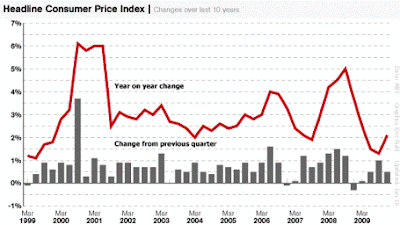
The actual CPI growth over the year was recorded in the September quarter (1%), and the RBA has already accounted for this growth by increasing the cash rate at both its November and December meetings (it raised it at it October meeting but September quarter data would not have been available at that time).
In truth, I'm surprised to see the December quarter CPI as low as it is. In fact, what we see here is a reduction in price growth over the December quarter (albeit December quarter on quarter growth has historically been significantly lower than other quarters). Quarter on quarter growth for September quarter was double that for the December quarter.
And, irrespective of the quarter on quarter increase, the data only reflects an annual increase in CPI of 2.1%, well within the bounds of the RBA's target zone of 2% to 3% per annum.
No problems... yet
Wednesday, January 6, 2010
Public transport efficiency in a standard work week environment
There has been a running discussion between Cameron Murray and myself in the comments section of one of his blog entries and I decided the issue deserved a blog entry unto itself.
As a throw away comment, I mentioned that there may be some efficiencies in public transport provision stemming from the standard work week. I may have started something here I cannot finish but I'll try anyway.
Increasing the use of public transport utilisation is efficient in that it reduces the average cost of provision, it reduces expenditure on private motor vehicles and it reduces the environmental externalities resulting from private motor vehicle trips.
The standard workweek increases the convenience of public transport and, as such, increases the number of people utilising public transport services. Ceteris paribus, increasing the number of people using public transport reduces the average* cost of provision per user.
Furthermore, on a general equilibrium level, having strong public transport utilisation provides significant efficiency benefits to society through reduced investment in, and use of, private motor vehicles. For example, if every bus takes two full loads of commuters to work each day, it would reduce the number of motor vehicle trips by over 100. This reduces commuters’ need to purchase a car and reduces the environmental externalities coming from the saved trips.
So, if there are efficiency benefits from improving public transport utilisation, how can we make public transport attractive to commuters? By making it convenient.
Taking a step closer and looking at only the efficiency of public transport provision (as opposed to efficiency of society), there is always going to be a trade of between efficiency and convenience in public transport provision (up until the point where there is sufficient critical mass in a city to efficiently provide constant public transport services – every ten minutes or so, 24-7).
The idea of inefficiency in public transport provision comes from having capital (both human and mechanical) being underutilised or lying idle. Having an even flow of people throughout the day (as opposed to a standard workday with peaks in the morning and afternoon) could mean that the same number of people could be serviced by fewer busses and trains. And this would be seen as an efficient outcome: i.e. if the same number of people could be serviced by public transport with fewer resources dedicated.
However, public transport utilisation, (as opposed to provision) is linked to efficiency in the convenience sense (and the economic sense on a societal level). In order to make busses and trains attractive to commuters, services must be far-reaching and constant, at the times when people need them. If services are not convenient – both in timing and route – the number of people utilising public transport will be low.
Moving away from the peak-period public transport would considerably reduce the convenience and thus utilisation on public transport. By moving away from peak periods to an even-flow of commuters throughout the day, the average time a commuter has to wait for a bus or train would increase (because the services would not be as regular as they are in current peak times) and the average distance that commuters have to travel to get on public transport would increase (because services to outlying areas would become unviable).
As such, the number of people using public transport would decrease over time because it would be inconvenient to use it. This would reduce the efficiency of the public transport system and society as a whole.
I guess if we break it down to first principles, in both an even-flow** and a peaky workday model, there would only be two efficient public transport provisions:
(1) zero investment with zero commuters (which would be inefficient for society as a whole); or
(2) a city with 24 hour critical mass to run constant services 24-7 – of which there are few examples in the world, perhaps Manhattan and Tokyo could be efficient.
As such, if efficiency in public transportation is the goal, irrespective of whether we are an even-flow or peaky workday economy, we should have no public transport.
If instead, efficiency in the economy as a whole is the goal, then the model that would meet the needs of a greater number of commuters would be the most efficient.
To me, that would clearly be the peaky workday model.
*marginal costs in infrastructure investment often provide poor a measurement of effeiceincy due to the peakyness of investment. e.g. the MC of adding one person to a full buss is the entire cost of a new bus, the MC of adding a second person is (near to ) nothing. As such, while a little rough, average cost is a useful tool when measuring efficiency.
**every time I type even-flow I’m reminded of Pearl Jam... “thoughts arrive like butterfli-ies... oh, he don’t kno-ow so he chases them awayayay".
(I'd also like to note the irony of two cyclists arguing about PT).
Wednesday, December 2, 2009
Where does money come from?
I love reading the stupid comments posted by CM readers.
Today I had the pleasure of reading through some classic comments that made me wonder - where do people think money comes from? Do people really think that the government's money is unrelated to their own?The article Queenslanders face electricity price hikes - Queensland households could soon face electricity prices that rise and fall with the temperature outlined the Queensland Competition Authority's (QCA) proposal to have different electricity tariffs in summer and winter, to reflect the higher costs of electricity over the summer period.
In its recently released Final Report - Review of Electricity Pricing and Tariff Structures, the QCA 'recognised that adding a seasonal component to some tariffs could be warranted'.
Irrespective of the outcomes of the report, what astounds me is that people think the outcome is related to public sector greed.
Notwithstanding considerable inefficiencies in the public sector, it’s not like the public servants are lining their pockets with tax payers money. Any over recovery of taxes simply gets spent in future years (like this year).
Fair enough, some of the comments show an interested person that needs to have the situation explained to them a little better (or who should read the QCA report rather than just the Courier Mail article), but generally speaking the comments show a complete lack of understanding of both the situation and of basic public finance.
'Just another way for Bligh to tax Queenslanders once more'
'hmmm.. so this means I'd pay more in summer because I use my airconditioner etc and therefore put a greater strain on the system by using more electricity? Umm.. sorry.. maybe I'm missing something here.. don't I already pay more in summer by the fact that I USE more electricity anyway? Obviously this is just another Bligh method of screwing us all over. Sooner this government is gone the better.'
'For Chrissake Electricity is a basic right. We pay enough for it now. Is it to become the right of the rich?'
'To hell with real costs; bring back the system we have had for the last 100years where we were not paying an arm and a leg for electricity.'
'You know how much more can these blood sucking leeches get out of the QLD people. They come up with all types of excuses and reasons but it all comes down to they just want to rip us off as much as humanly possible. Dont forget it was labor that got us into this mess with electricity with Peter Beattie promises of
cheaper power and now look whats happening. Can you image what it will be like when Bligh sells off all of QLD.'
And of course, my favourite comment always comes from the conspiracy theorist:
'I will never have one of those government meters in my home, they will be used to spy on me and my family and eventually will be used to switch off any of my appliances the government does not like. Seig Heil Herr GoAnna!'
Sunday, November 22, 2009
Speed Camera's: The User Pays System
I've never really understood the stance that speed cameras are bad because they are revenue raising. Surely, it is a great outcome for the user pays enthusiasts around. Why shouldn't the police force be funded by people breaking laws?
The front page of Today's Courier Mail was emblazoned - Tunnel Vision - Brisbane's new tunnel will open with eight speed cameras. The article is backed up by the editorial Save lives first before issuing fines.
My questions is, so what? Why shouldn't the police force raise its revenue in this way? It seems logical and reasonable to me that the police force be funded by people breaking the law. And if you don't want to pay more than the absolute minimum, don't bloody speed.
The down side is that the market is incomplete, causing equity issues in the proportion of police costs being collected from speeding fines. To rectify this we should increase the scope of this type of revenue raising. People convicted of all criminal activities should be expected to bare the reasonable 'police costs' involved in catching and convicting them. The system could be implemented in a similar way to court costs.
Is this a ridiculous idea, or a step in the right direction? It would help ease state government costs and it would add realistic punitive costs to crimes. It may also be suitable to use this in lieu of other punishments for less severe crimes (similar to a fine, but cost reflective rather than reflective of the seriousness of the crime).
Clearly there would be some argument that this would be hitting people while they are down, especially given that it is often those people in the lower socio-economic categories that are repeatedly in trouble with the law. But surely a fine is better to face than a jail term.
And either way, people should take responsibility for their actions. If you act in a way that requires a significant amount of police time, you should pay for that time.
If you speed, and are so stupid as to not slow down after the third "speed camera ahead" sign, you should suck it up and pay your fine.
If it was me, I wouldn't complain, I'd keep my mouth shut. I wouldn't want anyone to know I was dumb enough to get caught by a stationary speed camera.
If nothing else, you can always try the Mythbusters approach to avoiding speed cameras.
Clearly there would be some argument that this would be hitting people while they are down, especially given that it is often those people in the lower socio-economic categories that are repeatedly in trouble with the law. But surely a fine is better to face than a jail term.
And either way, people should take responsibility for their actions. If you act in a way that requires a significant amount of police time, you should pay for that time.
If you speed, and are so stupid as to not slow down after the third "speed camera ahead" sign, you should suck it up and pay your fine.
If it was me, I wouldn't complain, I'd keep my mouth shut. I wouldn't want anyone to know I was dumb enough to get caught by a stationary speed camera.
If nothing else, you can always try the Mythbusters approach to avoiding speed cameras.
Subscribe to:
Posts (Atom)
